- Home
- Dx insights
- Why in 2026 is it still so hard to digitalise your business
Why, in 2026, is it still so hard to digitalise your business?
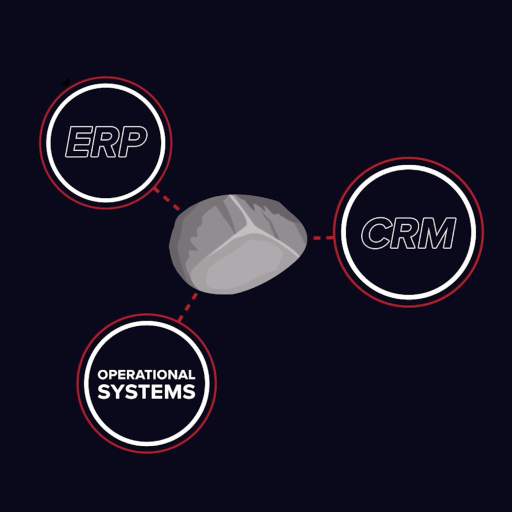
- Customising their ‘big rocks’, which is understandable as an initial strategy. Often, companies have made a substantial outlay for these systems and are trying to maximise the return on their investment. Further, core system vendors encourage their clients to use the vendor’s customisation tools to develop new capabilities and build solutions that are often outside the specialty area of that vendor’s system.
- Purchasing various (often departmental) off-the-shelf products that solve specific problems but can’t integrate with the enterprise systems.
- Building software from scratch using programming languages (e.g. mobile apps) and integrating them back into the ‘big rocks’ directly or through middleware. Hand coding has become incredibly complex, slow and expensive.
- Automating the repetitive parts of a process using robotic process automation (RPA) tools. This works well for automating simple manual tasks but not for human-centric workflows.
- ‘Big rocks’ are hard to customise, even using the vendor’s own development tools. Some well-known SaaS vendors provide some no-code and low-code capability for customisation within their environment. In reality, these limited tools can only take you so far before you must employ proprietary high-code to meet the functionality requirements. Excessive package customisations usually contribute to the pain and cost of core system upgrades every 3-5 years.
- Each ‘big rock’ introduces their own languages and toolsets, requiring a multitude of skill sets, which are costly and complex to manage. No-code, low-code, JavaScript, APEX, ABAP, Eclipse and Spartacus are just a few examples of the software development toolkits offered by the biggest packages in the market. Often, these languages and toolsets are proprietary, which makes it expensive for companies to keep their customised systems evolving. Further, IT leaders are left with the headache of finding and retaining a highly qualified army of professionals within their teams and/or manage a multitude of vendors.
- End-to-end digital processes cut across ‘big rocks’. Today’s business requirements include the delivery of unified customer and employee user experiences or end-to-end digital processes that require integrations and synchronisations across multiple core systems. Most companies can find it hard to know which core system to extend to achieve the desired results. This approach can blow out your budget with licenses if the new processes involve many users.
- ‘Big rocks’ lead to fragmented UI: When companies have multiple core systems, they end up with multiple types of user interfaces, creating fragmented experiences across (and sometimes within) their ecosystems, both for their customers and employees. Customers end up with multiple sign-ons to manage their accounts or services, which is frustrating. Employees must log into many systems and double-hand tasks to complete their jobs. Improving and integrating the UI of each different system is unmanageable and doesn’t create the smoother user experiences needed to increase user satisfaction, operational efficiency and uptake of digital offerings.
- ‘Big rocks’ don’t offer great UX: There’s no avoiding the fact that the UI tools that come with core systems are typically limited. Without a lot of coding, they simply aren’t capable of achieving pixel-perfect UI on any device – web, mobile or PWA – which are must-haves to compete effectively in today’s B2B or B2C spaces.
About the Author:
[custom_like] Share on LinkedIn
Lastest DX Insights
Victoria Police - Going Digital
[e-Book] – Tech Debt is robbing business right in front of our eyes
Will AI Replace Low-Code? Gartner answers.


Need a digital solution tailored to your needs?
Our team is here to help. Complete the form below and we’ll be in touch shortly.